Role
Product strategist + designer
Owned
0-to-1 product development
Company
CGI x Northwestern University
Timeline
Sep 2025 – Jun 2026

Challenge
Enterprises are spending heavily on AI tools, but most employees try them once and don’t come back. CGI, a global IT consulting firm, saw this across its clients: training programs existed, but they sat outside real work. Our research showed employees were willing but short on time, and drop-off happened at two points: day zero, and weeks three to six, once the novelty wore off.
My role: Product strategist and designer on a six-person team, working across problem definition, product design, and the business model, including pricing and market sizing.
The goal: Make AI learning part of how employees already work, not another mandated training.
The solution
Personalized training by role and behavior
A short assessment sets two things. Role type (functional, technical, or hybrid) determines challenge content, and a behavioral profile determines format and rewards. This gives personalized paths without dozens of static ones.
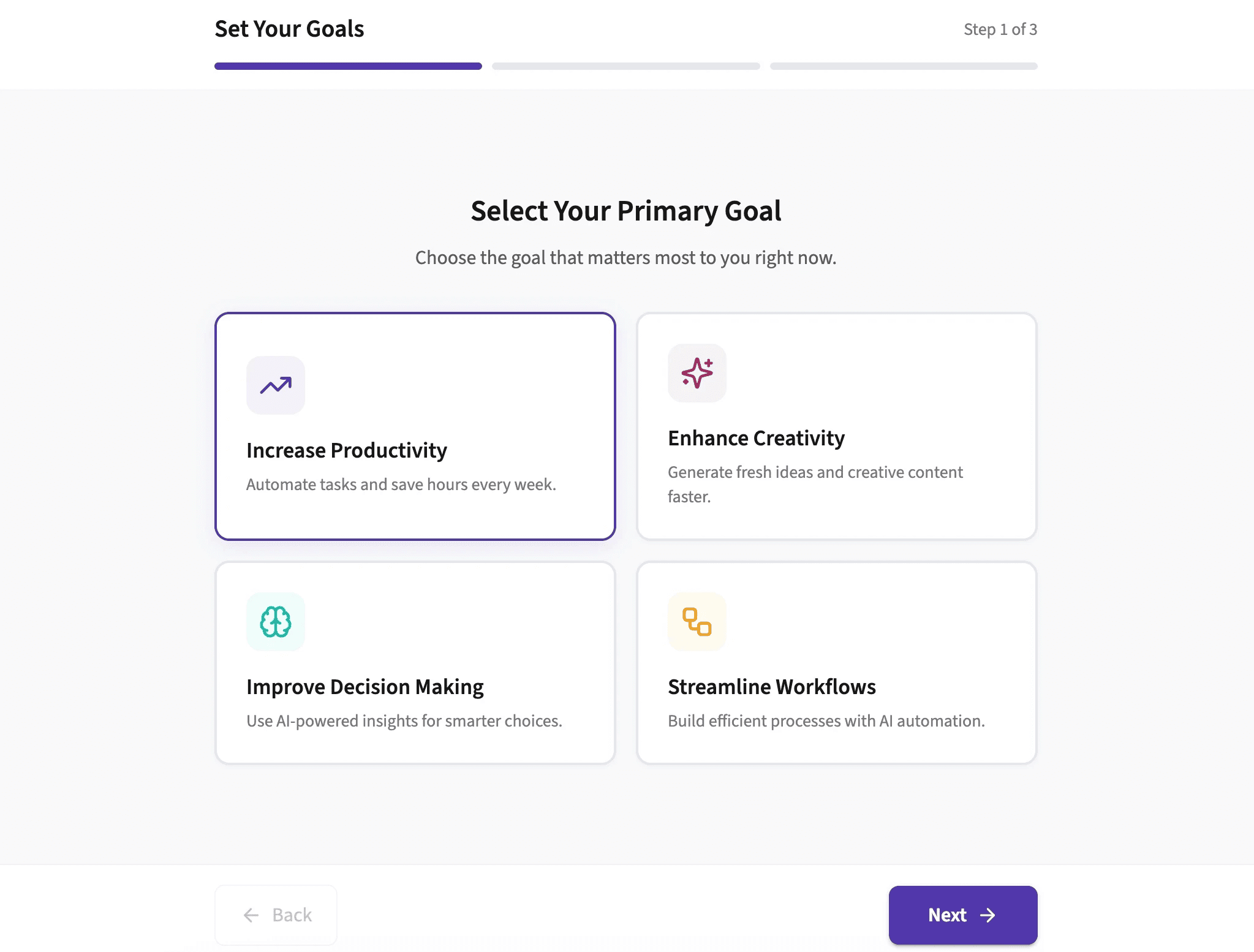

A challenge loop built for the drop-off points
We scoped the MVP to onboarding and daily challenges, the parts users touch every day and where drop-off happened. Challenges are short, tied to the user’s actual job, and link straight to the AI tools their company already licenses.

Designed to feel chosen, not assigned
We built our own visual language instead of CGI’s enterprise design system. If it looks like something IT sent you, it’s already lost. The warmer, consumer feel was a behavioral decision as much as a visual one.

Outcome
During a three-month pilot with 2,000 users at multiple companies, here’s what happened:
31% less rework by day 30
23% more output in the same hours worked
4.5 hours saved per week per employee
How this got built
We ran three rounds of in-depth interviews: 15 professionals across industries, then six pilot users split between high and low engagement. A card sort with pilot users showed they wanted a home base for progress and a launchpad to their AI tools, which became the MVP structure. We built a high-fidelity prototype in Figma and Claude Design, deployed it on Vercel, and tested pricing and marketing with about 75 enterprise buyers.